Skip to content

Blog

Journal Archive

Essays, stories, and updates from Corie Adjmi.

Desire and Marriage: A Paradox?

September 17, 2014

Desire and Marriage: A Paradox?

My friend sent me a text at midnight: I need therapy. She’d just had dinner with a couple that have been dating for three months. She’s been married for twenty-five years. My husband doesn’t look at me like that. We have to discuss this. Why doesn’t my husband look at me like that? Laughing so hard I thought my stitches would pop, I wrote: I just sent my husband to buy me stool softener. Maybe that’s why. (In thirty years of marriage I’ve never asked this of my husband but post-surgery...) Anyway, isn’t that the point? When you live with someone, share a life with someone, a real life, can there be mystery? My final text before going to sleep was, You can’t compare three months of dating to twenty-five years of marriage. But I woke thinking about this. According to Ester Perel, a NYC therapist and best-selling author of Mating in Captivity, “Desire needs distance, freedom, dream, mystery. It is that very freedom that allows us to maintain desire that also has the risk to separate us. The freedom posits risks but without freedom we don’t maintain the intensity of desire.” It seems impossible to have distance, freedom and mystery in an intimate long-term relationship. But Perel writes, “Reconciling the erotic and the domestic is not a problem we can solve; it is a paradox we manage.” There is a well-known cartoon by Sam Gross that was printed in the New Yorker. Two snails are talking. They are staring at a scotch tape dispenser and one snail says to the other, “ I don’t care if she is a scotch tape dispenser. I love her.” The shapes of these things appear the same but what else is known? This is what we do in the beginning of a relationship. We see some things and we conjure up the rest; part fantasy, part denial. And the distance and mystery stokes yearning. Ester Perel asks an important question in regards to her work on desire. Can we want what we already have?

Doodle Power

September 9, 2014

Doodle Power

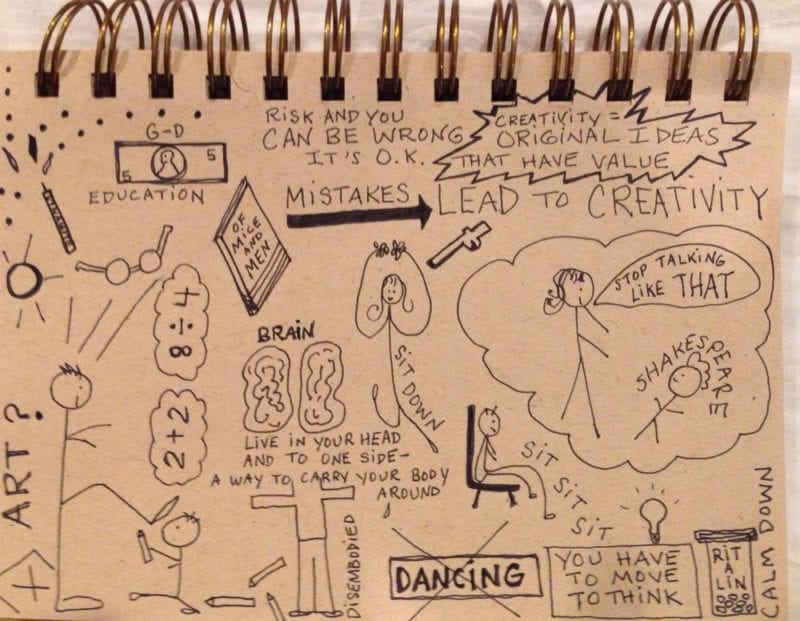
If you google most popular TED Talks the first one listed is Ken Robinson’s: How Schools Kill Creativity (2006). I was fortunate enough to go to Isadore Newman School in New Orleans, where creativity was valued. In fourth grade, I had the opportunity to sit on a carpet with my classmates and sing Langston Hughes poetry while our teacher played the guitar; and in fifth grade, my homework was to bake homemade bread when our class studied the Pioneers. Newman recognized something in me; and so while my friends in other classes memorized multiplication facts, I designed the classroom bulletin board. At the time this method of teaching was quite progressive. It was before Howard Gardner wrote, Frames of Mind: The Theory of Multiple Intelligences (1983.) In his book, Gardner proposes that intelligence should not be measured by a single ability but should be differentiated into specific, primarily sensory, modalities: musical, visual, verbal, logical, bodily, interpersonal, intrapersonal. My experiences at Newman affected me greatly and as a fourth and fifth grade teacher, I wanted to educate in a similar way, a way I believed was essential. At NYU and then at Bank Street College, where I received my graduate degree, I learned about educating the whole child; providing meaningful experiences, and a variety of materials, in order to create an environment in which children could learn to their full potential. But at school in New Orleans, I didn’t understand why I got to skip math in order to practice my balance beam routine. I thought I was getting away with something, beating the system. The staff at Newman understood that in order to educate me, and others like me, it would require something more than sitting in a chair for eight hours straight, staring at the blackboard. I would need to dance, draw, sing. In sixth grade, however, in science, I received the first and only "D" I ever got on my report card. My parents went ballistic, and grounded me. Wanting to leave my room, I promised to work hard and pull up my grade. One day, my science teacher lectured about clouds: cumulus, stratus, cirrus, nimbus. I sat in the front row and doodled. My teacher was generally a nice man, and probably a proponent of progressive education, but given my report card grade, the squiggly drawings on my notebook aggravated him; and he ordered me to put the sketches away. It was one thing to value the arts in a classroom but doodling? I was humiliated in front of my class, not only because he’d scolded me; but because I really had been listening, and hated that he thought I hadn’t been. I wanted to show him that he was wrong, that I could doodle and pay attention, in fact maybe even better attention than if I hadn’t been doodling. And I did. I showed him. I got a 92 on the next science test. But it wasn’t until last week, almost 40 years after the day I doodled in class, that I found scientific research to back me up. After I watched Ken Robinson’s TED Talk, How Schools Kill Creativity, I wanted to tell others to watch it. (The TED tagline is Ideas Worth Spreading.) In trying to summarize the content of the video, I could barely retrieve a single detail other than what the title inferred, and this upset me. Why was my retention so poor? Inadvertently, a few days later, I stumbled on Sunni Brown’s video on Doodling. Doodlers, Unite! Brown says that studies show sketching and doodling improve comprehension and creativity. Further browsing led me to a site on graphic note taking, which is basically another name for doodling. I know I need to write things down, see them, in order to remember them. I’m not an auditory person: in one ear, out the other, as the saying goes. But once I take pen in hand, and can see the words or pictures on a page, the images are etched in my mind, the details stored. But I'd forgotten, or at least minimized, how essential this was to me as a learner. So, I listened to How Schools Kill Creativity again; but this time, I doodled as I listened and graphic note taking, it turns out, is a great tool. The difference in my comprehension was incredible. I had no problem recounting how Ken Robinson is a creativity expert who is challenging the way we educate our children, reminding us that schools need to nurture, rather than undermine, creativity, and to acknowledge multiple types of intelligence. I tried graphic note taking while I watched Brene Brown’s TED Talk- The Price of Invulnerability. (I highly recommend her talk- The Power of Vulnerability as well.) I joke now that I could recite these talks, verbatim. The power in doodling is just one of many ideas worth spreading.

Attachment Theory: Letting Go Of My Uterus

September 2, 2014

Attachment Theory: Letting Go Of My Uterus

I’m attached to my uterus. I’m attached to a lot of things. People mostly. But I’m sentimental so I get attached to my clothes, my books, and yes, even my uterus. Sometimes what you resist persists, right? Life has a way of teaching us what we need to learn and so my children have grown and I’ve had to work hard at healthy separation, I live with two daughters who steal all my clothes (especially when I’m out of town) and we had a fire in our house a few years back- bye, bye books. Now it’s my uterus that’s on the line. I’m scheduled for surgery in 2 days to remove a 10 cm (that’s the size of a grapefruit) fibroid (a non-cancerous tumor) from my uterus. The discovery of this fibroid was one of the scariest days of my life. (More on that in another blog post.) Not wanting to part with my uterus, I’ve put this off for years. The surgery is considered elective but I’ve grown tired of regular sonograms, more than my fair share of scares, feeling six months pregnant and having to leave the dinner table doubled over with cramps. Maybe I should have done this sooner but like I said, I’m sentimental and my uterus has been good to me. Five children have grown in there. I don’t take that lightly. So it seems reasonable that I’d be attached. Plus, it seems perfectly normal and logical to be attached to all my body parts. Doctors talk about removing a cervix, ovaries and fallopian tubes as if they were manicurists removing nail polish. “When the fibroid goes, my uterus goes too,” I explained to my oldest daughter. “And the problem is?” “I want my uterus.” “That’s weird. You don’t need it.” And of course, she’s right but need is a funny word. My uterus feels connected to my youth and so there is a sense of loss. Plus, why’d I grow the fibroid in the first place? Unresolved emotions. Pent up anger. Who knows? I will tell you this- fibroids are common. Forty percent of women get them. But they are most common in African American women, women who are obese and women who eat lots of red meat, especially ham. I am none of these. I tried to explain to my daughter that I didn’t believe you could just cut these things out. It’s the size of baby’s head. Coincidence? “Okay, that’s super weird. And gross,” she said. “Just get it out. It’s a foreign something growing in your body.” But that’s just it. It didn’t feel foreign. And for a long time, I wasn’t ready to let it go. Along the way, I’ve had to fight to keep other body parts. Literally argue. Up until recently a woman’s ovaries were thought to do nothing after menopause (just for the record, that’s still years away) and were taken out without much discussion. It is now known that ovaries actually continue producing hormones for years. Hormones that I want! I had a similar debate over my cervix and fallopian tubes. All of which are staying. As my mother says, with not a small amount of disdain, “You have to be your own doctor.” The point is you must do research and ask questions. One doctor wanted to morcellate the fibroid, cut it up into small pieces so I wouldn’t need a big surgery in order to get it out; and a different doctor said morcellating wasn’t a good idea. Turns out, even though the numbers are small, it is possible to have one bad cell, which once exposed could spread disease. (Yes, getting that information was one of the scary days.) So it has taken time but I have accepted that my uterus will go. There comes a time for things, and when the right moment presents itself, you know. When my youngest son was three, my mother asked, “When are you going to cut the umbilical cord?” Like I said, separating is difficult for me but I did separate from him; and now he lives on his own, holds a steady job and plays drums in a band. Everything in due time.

What you don't know about addiction

August 26, 2014

What you don't know about addiction

I grew up in a house with a bar that spanned the length of the living room. I thought as little of the bar as I did of our couch, the coffee table or any other piece of furniture in the room. Granted, the bar had a mirrored front and a sleek wood top, which proved glamorous and alluring, but my parents weren’t addicts, they were partiers. When my husband and I had the opportunity to decorate our living room, we built a bar equally as sleek as my parent’s bar and it took up a good portion of the living room. I never thought about the message this sent my children or what I was unconsciously teaching them. Entertaining one Saturday afternoon, a friend caught my eye. I watched him stroll to the bar many times over the course of the day filling his glass with scotch again and again. After about ten trips to the bar I lost count. I wasn’t concerned or shocked. The only thought I had about how much he’d consumed was, boy he can sure put it away. This was a friend who’d been married for fifteen years, had five children, drank scotch straight from the bottle, often fell asleep in his clothes on the couch, and at times woke with no memory of the evening before. How is it possible that when he went to rehab, I was surprised? I write about this now because I want to call attention to how unaware we are of the enormous and immeasurable ways addiction impacts our lives and how the values of our culture, community, family, along with our childhood experiences and our feelings of self worth play a part in how obsessions show up, sometimes unexpectedly. I’m not an addiction expert. I’m a writer, a teacher, a mother, a woman living in a tight-knit community, who has witnessed the progression of something so alarming and prevalent it has become impossible to deny any longer. In Connected: The Amazing Power of Social Networks and How They Shape Our Lives, the authors claim that how we feel, what we know, whom we marry, whether we fall ill, how much money we make and whether we vote all depend on the ties that bind us. But Social Networks don’t distinguish between good and bad, so they spread happiness, generosity and love... but also eating disorders and alcoholism. Tina Rosenberg’s book, Join the Club: How Peer Pressure Can Transform the World, argues that peer pressure can lead to acts of bravery or destruction (depending on the trend) and that through social networks we could transform the world. Rosenberg asks us to re-imagine social change based on the most powerful human motivator: our desire to connect with one another. And she refers to this phenomenon as the “social cure.” I saw this happen firsthand. When the man who drank scotch straight from the bottle returned from rehab, he surrounded himself with other recovering alcoholics and attended Alcoholics Anonymous, a social network. He lived according to the program, one day at a time. But within our community, outspoken, he stood out until a few months later, another community member got sober. Together they seemed to stand taller than they did on their own. They made recovery look good. They didn’t talk about how much they missed drinking. Conversely, they spoke about the benefits of sobriety. They could participate in their own lives again, be reliable family members and concentrate at work. Fun-loving and charismatic, they turned what was once perceived as shameful or undesirable into something that was not only accepted but respected; a loser move had become cool. They were a dynamic duo and were suitably named Batman and Robin - Caped Crusaders. It wasn’t long before others recognized their serenity and wanted some too. I watched as person after person joined the bandwagon. Individuals who’d struggled, unable to remain sober, were finally able to stick the program. The group, attractive, grew. The social ties were spreading recovery. A few years ago, we had a fire in our house and needed to redecorate the living room. This time: without a bar.

It Worked For Bruce Springsteen

August 12, 2014

It Worked For Bruce Springsteen

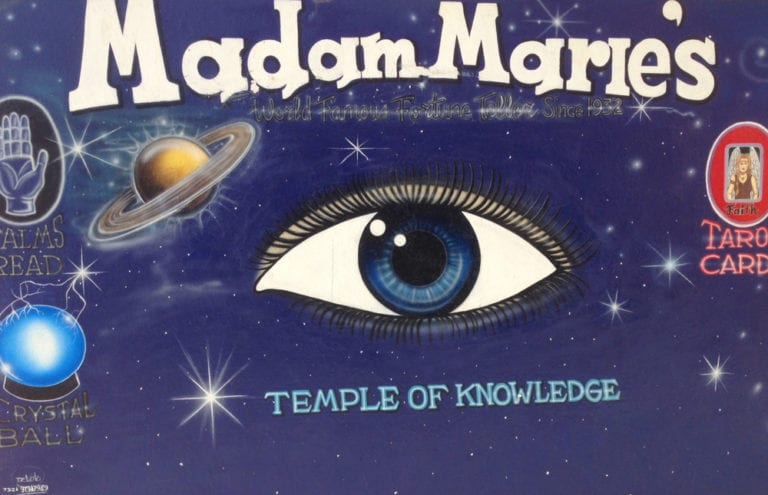
Last week, driving in the car with two friends and feeling a bit playful I said, “Let’s go to Madame Marie’s.” “Who’s Madame Marie?” they asked. “Are you kidding?” They weren’t. They didn’t know Madame Marie was a fortuneteller on the Asbury Park boardwalk; or that her clients included Ray Charles, Elton John, Diane Keaton, and The Rolling Stones. Reportedly, Madame Marie told Bruce Springsteen he’d be a huge success; and he wrote about her in his 1973 song, 4th of July, Asbury Park. “Did you hear the cops finally busted Madame Marie for tellin’ fortunes better than they do.” Madame Marie was an icon on the boardwalk for decades and as she aged, she trained her children and grandchildren to read tarot cards and crystal balls. I see her granddaughter, Sabrina, who for $25.00 reads my palm. I should get a kickback because every summer I visit her and bring friends. Relatives. Anyone who’ll come with me. Two years ago I brought my cousin, Pam. I went first. Sabrina studied my palm and told me I’d live a long life. “You’ll live until you’re ninety-two,” she said. I was thrilled. “I’m going to live a long life,” Pam said after her reading. “Eighty-six years old,” she boasted. “Oh, Pam,” I teased, “I’m going to miss you those last few years.” While we laughed out loud, inside I panicked picturing myself as a 92 year-old woman; and if that wasn’t bad enough, I tried to envision a world without Pam in it. I brushed away the thought. Part of me recognizes that Sabrina can’t possibly know this to be fact but she’s been right about so much. Yes, I had a friend who got sick and needed me. Yes, she was on the money about a specific guy a different friend was dating. And yes, there was something about an upcoming medical procedure. *** My two friends were torn, half excited by the idea of having their fortunes told, and half skeptical. “Come on,” I said. “You’ll see.” It was around six pm, a time that for as many years as I can remember was dinnertime, bath time, homework time. It hadn’t been my time since I was twenty and so this felt outlandish and adventurous. It was also a perfect summer evening, the air off the ocean a gentle breeze, the temperature perfect. I took off my shoes and walked barefooted on the boardwalk. After my reading, I smiled wide. “What did she say?” my friend asked. Here’s the thing: you’re not supposed to share your reading. Was that so she could scam us? Tell each of us the same thing? (There was one year she kept asking, is there a Michael in your life?) Or was it because of the old superstition not to reveal your wish if you want it to come true? (How many times have you wished on a star or a chicken bone and not told fearful your dream wouldn’t come true?) But there is another belief. Say your wish out loud. Yell it to the universe and it will come true. So here it is, the good thing Sabrina told me the other day… She said that something positive was going to happen with my novel in September. “You hear that! All literary agents- you have until September!” There it is. I’ve said it. My wish is free in the world. It’s up to the universe to respond. Or not. Every day since my visit to Madame Marie’s this summer, I think about Sabrina’s words. Every day I get a bit giddy imagining she’s right. For $25.00 a world of hope and possibility opened up for me. There was something special about that evening: the spontaneity, the ocean air, the purple sky. It was girly and fun, like the world was my oyster, and that all the opportunity in the universe rested in the palm of my hand.

The Other Woman

August 6, 2014

The Other Woman

I resist technology. My family jokes that I can’t turn on the television but that’s not true. What is true is that I like some hi-tech advances and refuse to go along with others. I’ve stopped calling 411 and now use Google; but I still insist on looking out the window instead of using a weather app. In France, last summer, Mark reserved a rent a car with GPS. I hated the sound of the woman’s voice. She kept barking out orders and interrupting every conversation. “Can’t you turn that thing off?” I asked. “No, we need it,” Mark insisted. “No we don’t. She’s always wrong.” “That’s ridiculous.” Call me stupid or old-fashioned but I wanted to get us where we were going. I wanted the challenge. I get that going it on our own wasn’t imperative, and could be construed as unnecessary as someone insisting on memorizing a cell phone number instead of adding it to contacts. But getting lost and finding our way, I claimed, was part of the journey, wasn’t it? Mark likes to call the shots, do things his way. It’s difficult for him to accept influence from me; in life and in the car. So when the GPS told him to take a left and I said to take a right, he listened to the GPS, defending the voice from the navigation system with vigor. “I can’t believe how you’re sticking up for this thing,” I said pointing at the dashboard. “It’s like there’s another woman in our car.” The GPS voice droned on. “Marguerite. That’s what I’ll call her.” “Call who?” Mark asked. Before long, we were lost. I know you must be thinking that’s not possible. But that’s the thing about technology, if the program or setting is off, if the computer is inadvertently told to do the wrong thing, you’re going to end up with a problem. So, we got lost. Marguerite had us going in circles. “I told you to take a right,” I said. “You have to use your head and common sense. You can’t follow blindly. Bad things happen when people follow blindly. Look what happened during World War II.” “Don’t you think that’s a bit dramatic?” Eventually, with my help, we found our way to the highway. We zoomed on, parallel to the sea, Mark going way too fast. Instead of enjoying the beautiful flowers and trees along the roadway, I sat stiff and kept imagining my funeral, wondering if the upcoming tunnel was like the one Princess Diana died in. “You’re going too fast. Please slow down.” “I’m going 110 kilometers. Everyone in France drives this way.” “Please slow down.” When you sit in the passenger seat, you give up control. I had flashbacks of the time our rent a car soared over a cliff in Colorado; Mark, me, and four of our children inside. The car landed on a boulder, perched like a bird in its nest, instead of rolling and rolling, but it was totaled; a huge crack in the windshield where my bare foot had landed. I’d tried to control the situation, stop the car from going over the cliff, by stepping involuntarily on imaginary brakes. Remarkably, other than my sprained ankle, we were all fine. (Although my son, Richard claims he bit his tongue.) Mark slowed down and for a few minutes I was able to relax. He was okay when a Lamborghini sped past us but lost it when a Fiat whizzed by. Ultimately, we got where we were going. “Marguerite did a good job,” Mark said pulling up to our hotel. “She got us here.” “You’ve got to be kidding. I got us here.” “You’re jealous! I can’t believe you’re jealous of the GPS voice,” he laughed. And if I am honest, I was. I wanted him to listen to me. But instead I said, “That’s ludicrous.” “She does have a lovely voice,” Mark instigated. “Well then you can have dinner with her,” I said half-kidding, half-hurt. “She’s not perfect,” Mark said. “She doesn’t have your legs.” “She’s a controlling, manipulative, bitch who always thinks she’s right. She’s always telling us what to do and where to go.” “But when I drive the wrong way, she doesn’t yell at me. She nicely helps me find the right way.” We just bought a Tesla. It has an app that lets you change the temperature in the car from your cell phone. It’s meant to be a helpful feature, one that allows you to warm up your car while you wait in your house on a freezing cold day. But I’m miserable about it. I envision Mark sitting behind his desk, at his office, changing the temperature in our car from his cell phone while I’m driving and there’s no one even in the passenger seat.

July 29, 2014

Braces: The New Chastity Belt

At lunch the other day my friend sipped a glass of white wine and announced she’d convinced her daughter’s orthodontist to lie. She’d persuaded him to tell her daughter that her braces wouldn’t come off in June, as promised. They’d need to stay on until September. “She’s going to sleep away camp and I don’t want her kissing any boys,” my friend explained. “Genius,” a second friend laughed. “What!” I almost choked on my arugula salad. “You can’t do that to her.” “I can and I did,” my friend said. “I’m going to write about this,” I said, as if the threat would knock some sense into her. “Go ahead,” she chewed, unfazed. Sitting there, I remembered the summer of 1976. Camp Blue Star, the year of the bicentennial. I was twelve. I had a boy’s haircut and braces. That summer, I cupped fireflies in my bare hands and roasted marshmallows around campfires. I swam in the lake and did macramé. But what I waited for all season was the dance, The Social. Two days before camp ended, on the night of The Social, I borrowed a friend’s jeans and wore a bra for the first time. This was not a small leap; it felt gigantic. At the dance, I was nervous and self-conscious. Standing on the side, I watched. When Roller Coaster of Love played a really cute boy asked me to dance. Euphoria. My parents were conservative (although my father drove a red motorcycle and my mother, a petite Jewish woman, wore an afro) and so sending me to camp that summer was an act of faith—in me. After the dance, the boy walked me back to my cabin. Behind a bush, the most exciting thing happened. We kissed. I experienced a lot of new things that summer. On a hike, I saw a snake for the first time and near a blackberry bush, I was stung by a bee. I got a high fever, and in the infirmary—alone—I missed my mother. Wanting my friends to know that controlling their children wasn’t a good idea, I said, “You can still make out with braces.” But they wouldn’t relent. To them, kissing was a gateway drug. They had their beliefs and I had mine. I wouldn’t trade my experiences at sleep away camp for anything in the world, not even the moment I found out my trunk didn’t arrive and I had no clothes. I built muscle. I figured it out. There are times you have to let go: with your children and with your friends.

July 29, 2014

Stand Up Comedy at Omega

I stood on a stage in front of a few hundred people at Omega Institute for Holistic Studies, bright lights in my eyes. “I don’t know what I’m doing here,” I said to the audience. “I’m so not funny.” But I’d signed up for stand up comedy in an effort to change that and performing was our final project. “I did get my friends and family to laugh,” I told the audience, “when I broke it to them I was doing stand up.” My husband and children think you have to be mean to do stand up. At dinner, my daughter said, “Mom, you’re like Tinker Bell, and Tinker Bell is so not funny.” Our dinner table is like that. A battlefield. My children can be mean. They get that from their father. By comparison, I fall short. Recently I’ve tried to pick up my game, and the other night, I threw a spoon at my husband. I confess we fight a lot. I read in an Astrology book that we’re a perfect match- our verbal sparring foreplay. Personally, I’d rather a back rub. We are Syrian and my husband has dark skin. So do my kids. My husband thinks they look like him, and says I was just Fed Ex. He admits they have my ears, which isn’t a compliment because before I was Tinker Bell, I was Dumbo. My family fights about everything. They will debate, with vigor, if potatoes are better mashed or fried, if vegetable soup should be more vegetable or more broth. My kids are so mean they even make fun of vegetables. Imagine needing to be one up from a vegetable. Organic vegetables are the worst. They want meat: thick steaks, hamburgers, BBQ. And the terms hormone-free, farm-fed, and free-range piss them off. My family’s all brawn. They don’t believe in global warming and littering is just practical because as my youngest son says, “When I don’t litter, my car gets filthy.” When I gasped, he said accusingly, “I know you love water bottles.” And it’s true. I sneak them into my closet, pretending there is only one, and I admitted that on the stage at Omega which was way more daring and scary than doing the flying trapeze earlier that same day. But I’m changing. I gave birth naturally 5 times. Nursed them all. I made homemade baby food. I was an elementary school teacher. I had the patience of a Saint. But no more! Now the music on an ice cream truck makes me cringe -- nails on a chalkboard. Children splashing in a pool, irritating as ants at a picnic. So you see, I can be mean. As the old Syrian saying goes, if you put a cucumber in a pickle jar, you get a pickle. And just so you know, the audience at Omega laughed throughout my Stand Up routine. A woman came up to me after the show and said, “That was great. You should start a blog.” I laughed and said, “Now that’s funny.”